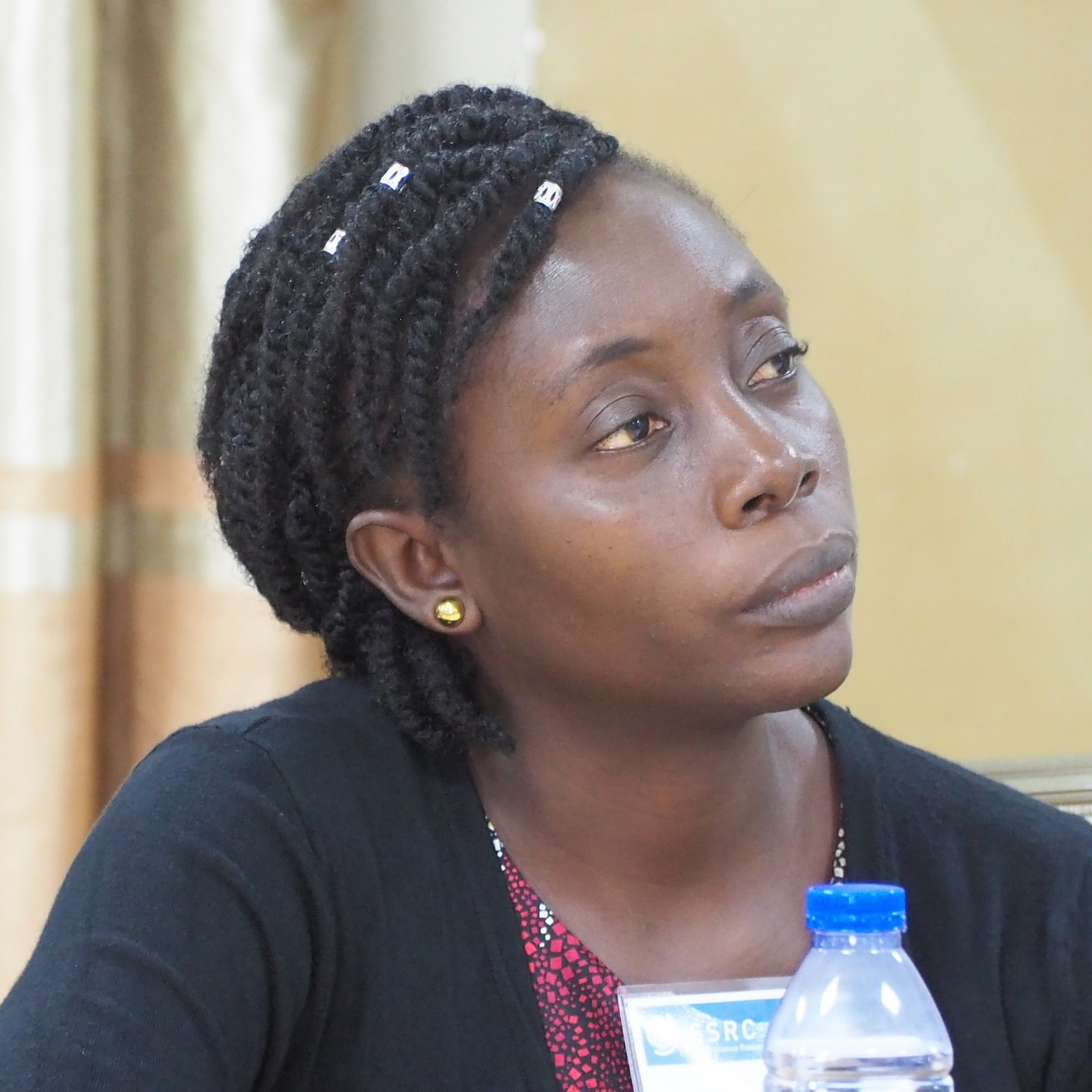
Fellows & Grantees
Patience Adzande
Urban and Regional Planning (at time of award)
SSRC Awards
-
2017
Individual Research FellowshipsPutting New Wine into Old Wineskins? Peacebuilding Strategies and the Changing Dynamics of Conflicts in Nigeria
Urban and Regional Planning
Project description
The study aims to find out if the current peacebuilding strategies adopted in parts of Benue, Adamawa and Plateau States in resolving conflicts between farmers and herdsmen are appropriate, adequate, effective and sustainable. This evaluation has become necessary in view of the changing nature, magnitude and dimension of conflicts, specifically involving farmers and herdsmen in Nigeria. The study argues that more nuanced and multipronged peacebuilding approaches are needed in the face of the emergent 'new wars' currently being experienced. The study is further anchored on the argument that conflicts are dynamic; and so, the peacebuilding process must be approached in new and creative ways. Thus, the study evaluates the potentials and challenges of current peacebuilding initiatives in conflict resolution in Nigeria. Evaluations such as that proposed by this research are necessary to enhance the quality of peacebuilding interventions and to ensure that peacebuilding approaches are tailored towards addressing the changing dynamics of conflicts in Africa and Nigeria in particular. Therefore, the study seeks to address the central research question: how do the existing peacebuilding strategies address the changing dynamics of conflicts in Nigeria?
-
2014
Doctoral Dissertation Completion FellowshipAnalysis of the Determinants of Crime Pattern in Makurdi Town
Benue State University, URBAN AND REGIONAL PLANNING
Project description
Preliminary spatial analysis of reported crimes in Makurdi suggests that particular types of crime tend to cluster in certain parts of the town. The study sets out to examine whether the clustering is related to the social areas of Makurdi. Social areas are made up of the physical and social environment. It is hypothesized that the social component influences the organization, perception and use of the physical environment. Specifically, the study seeks to determine what kinds of spaces are associated with the occurrence of crime and victimization; to examine the categories of people that are victimized in these spaces and to investigate why crime and victimization occur and cluster in these social spaces. Although efforts have been made in mapping social areas of cities in some countries, rare applications of these constructs in crime analysis exist. The study seeks to promote a planning response that is determined by local conditions.
-
2013
Doctoral Dissertation Research FellowshipAnalysis of the Determinants of Crime Pattern in Makurdi Town
Benue State University, Urban and Regional Planning
Project description
The objective of the study is to analyse the relationship between social and spatial characteristics and the pattern of crime in Makurdi town. Social areas are made up of the physical and social environment. The social component influences the organization, perception and use of the physical environment. Although, efforts have been made in mapping social areas of cities in some countries, rare applications of these constructs in crime analysis exist. Social and spatial characteristics of urban communities vary greatly across the globe; as such every city needs to be studied for what the social and spatial components are and what explains crime pattern in the social areas of the city. Makurdi, the capital of Benue state is experiencing increased population and spatial growth; a situation which has resulted to a corresponding increase in crime. The study is an attempt at examining the role of the environment in influencing criminal activities in urban areas.