
 Events
- This event has passed.
The African University Seminar Series Nigeria (AUSS-NG) held its inaugural seminar at the University of Abuja in Abuja, Nigeria, from September 27 to 28, 2025. Funded by the Social Science Research Council (SSRC)’s African Peacebuilding Network (APN) and Next Generation (Next Gen) Social Sciences in Africa Program and hosted by the Department of History & Diplomatic Studies, University of Abuja, the seminar assembled 26 APN and Next Gen fellows and alumni for a one-and-a-half-day convening on contemplating and “Reimagining Peace in Nigeria: Resilience, Reconciliation, Social Justice and Everyday Politics.”
An initiative by the APN and Next Gen Program to fund and support the self-organizing capabilities of APN and Next Gen fellows and alums in countries with critical numbers of fellows and alumni, the African University Seminar Series is rooted in the principles of fostering a distinct APN and Next Gen community of fellowship award recipients that advance the goals of the Program by organizing a set of scholarly convenings that center on peacebuilding, security, and development within country-specific contexts while facilitating networking and mentorship activities for early, mid and senior career scholars. The Program launched the first AUSS community in Kenya in 2023 and since launched others in South Africa and Nigeria.
The seminar opened with welcome remarks from Dr. Cyril Obi, Program Director of the APN and Next Gen Program, delivered by Program Assistant Ms. Maimouna Cherif. He acknowledged the support of the Carnegie Corporation of New York (CCNY) and the SSRC, noting the Program’s impact: 840 fellowships awarded across Africa since 2012, including 563 Next Gen and 277 APN awards. Dr. Obi emphasized the AUSS’s role in fostering a community of knowledge and practice, highlighting the significance of launching the Nigerian chapter due to the strong contributions of fellows in Nigerian institutions. He concluded by thanking the University of Abuja’s Department of History and Diplomatic Studies, the Faculty of Arts, and the Local Organizing Committee for their support, and he wished participants productive discussions.
Professor Muhammad Sani Umar, representative for the Head of Department, History and Diplomatic Studies, University of Abuja, followed with his own remarks. He commended the collaboration between the department and the program, highlighting the SSRC’s impact since its inception, and noting that it embraces the humanistic tradition of social sciences, with a very high respect for the scholarly community. Addressing the timeliness of the seminar’s theme, he emphasized the importance of “going back to the drawing board” in addressing the violence in the country.
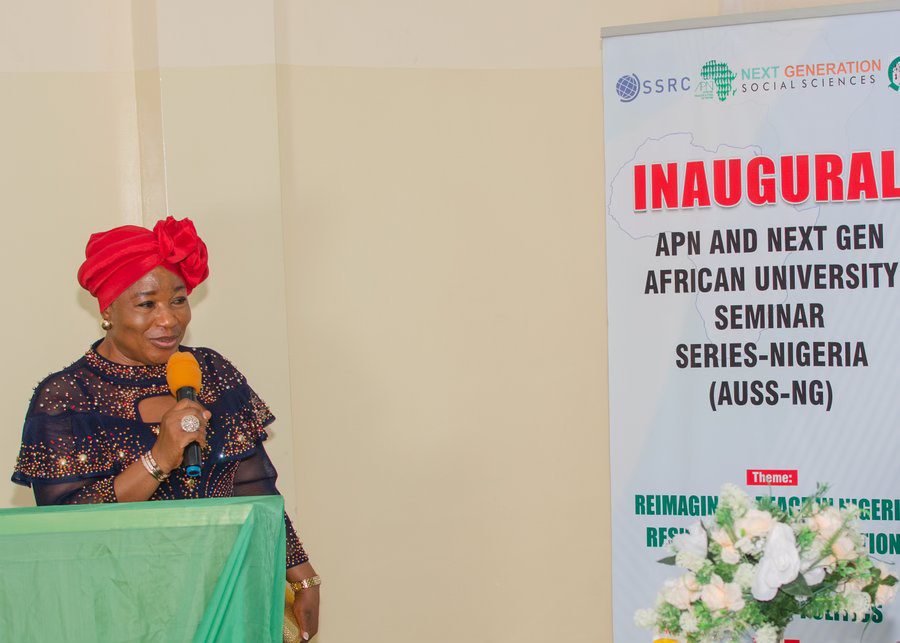 Following these remarks was a goodwill message from Professor Amuche U. Madu, Dean of Arts. She is at the University of Abuja and expressed her gratitude for the SSRC’s APN and Next Gen Program’s collaboration with the university, highlighting the importance of scholarly contributions to the topic of reimagining peace in Nigeria. LOC co-Chairs, Dr. Joyce Agofure (APN IRF 2022), Senior Lecturer and Researcher, Ahmadu Bello University, and Dr. Sani Y Adam (APN IRF 2024 and Next Gen 2018, 2,019, 2020), Lecturer, Bayero University, closed the opening session with a message of gratitude to the Program, the AUSS-NG co-advisors, the Department of History & Diplomatic Studies, University of Abuja, the keynote speaker, and the fellows and alums for their astounding scholarship and the breadth and quality of the papers submitted for the seminar.
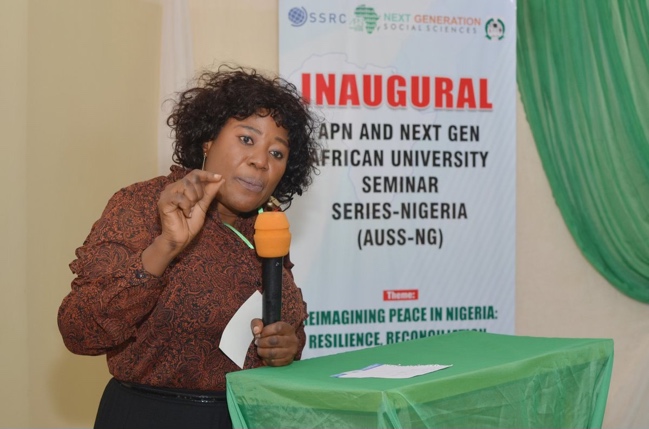 Professor Abosede Babatunde, Professor at the Centre for Peace and Strategic Studies, University of Ilorin, delivered the keynote lecture, “Reenvisioning the Local Turn in Peacebuilding: Traditional Leadership, Community Resilience and the Management of Resource Conflicts in Nigeria.” Using Nigeria’s resource conflicts as an example, Prof. Babatunde highlighted that although the idea of localizing peacebuilding sounds empowering in theory, in practice, it does not automatically, “by itself, lead to emancipation and can often promote exclusionary and divisive politics that contribute to violence.” Local contexts are often shaped by unequal power dynamics, where traditional authorities and certain groups dominate access to resources and decision-making. “New approaches to managing resource conflicts must consider how interventions feed into the ‘politics of the local,’” she urged.
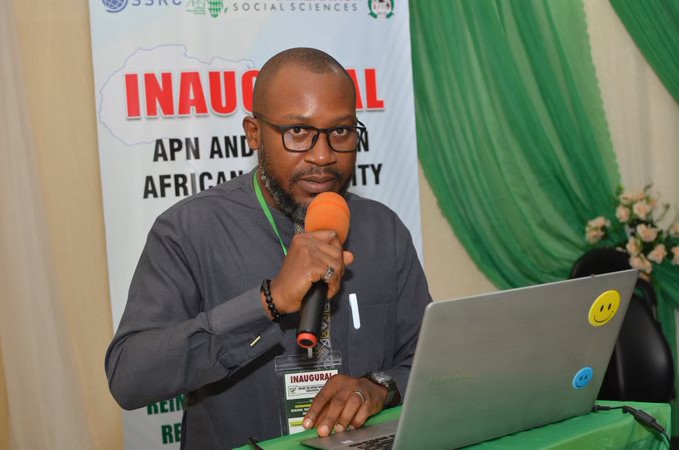 Following this, panel sessions commenced. The first panel, “Resource Conflicts, Governance, and Resistance,” emphasized that conflicts over land, forests, and natural resources stem less from scarcity and more from corruption and poor governance. Presentations highlighted how marginalized actors resist state control and negotiate survival through resilience and local peacebuilding. Case studies from the Niger Delta and northern Nigeria showed how environmental degradation, exploitation, and unequal resource distribution deepen insecurity and mistrust between communities, corporations, and the state.The panel also explored the limitations of current conflict early warning systems and government interventions, noting that top-down peace initiatives often fail to address local grievances. Underscored was that sustainable peace in Nigeria requires inclusive approaches that confront structural inequality and empower those affected by resource-based violence.
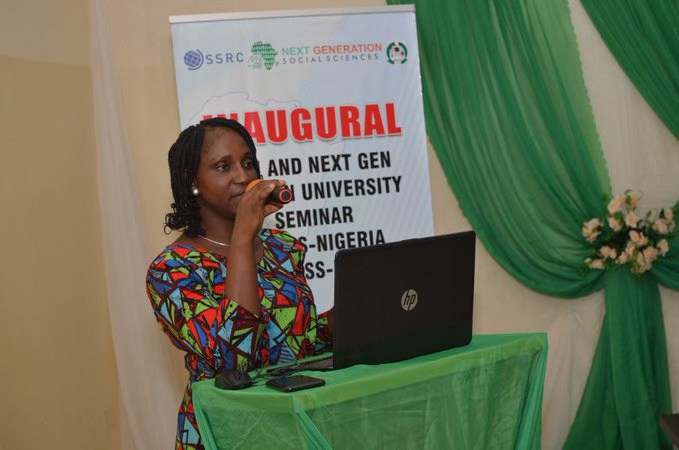 Panelists included Dr. Alaba F. Ogwumike (Next Gen 2018, 2019), Dr. Olugbenga S. Falas (Next Gen 2014, 2016, 2017, 2020), Dr. Joyce Agofure (APN IRF 2022), Dr. Chukwudi G. Njoku (APN IRF 2025), Dr. Imomotimi Armstrong (APN IRF 2025), and Prof. Justin Agheyisi (APN IRF 2022).
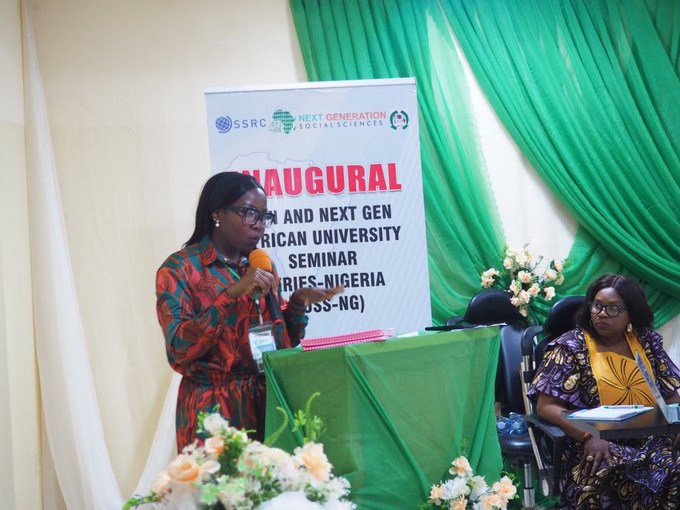 Panel 2, “Radicalization, Security, and Youth Activism,” explored diverse pathways to peacebuilding, security, and social cohesion in Nigeria, addressing how both state and non-state actors shape these. It began with a discussion on digital activism and its gains and inhibitors—using the #EndSARS protests as an example. Topics also included the Civilian Joint Task Force (CJTF) as an example of community-based initiatives that could shift from combative roles to non-kinetic ones, such as de-radi
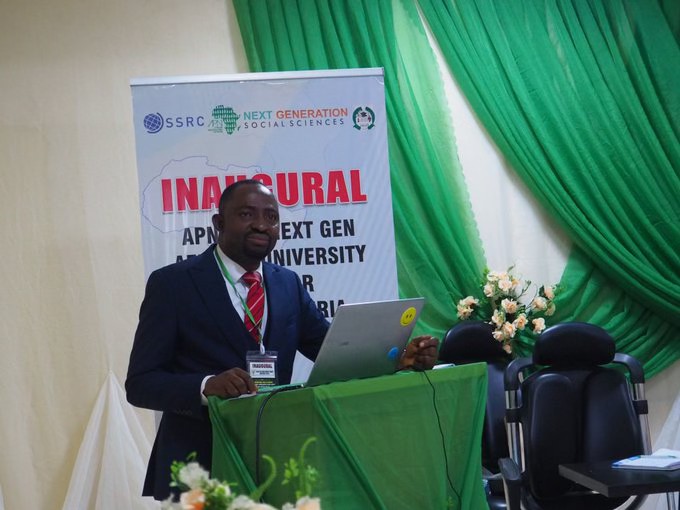 calization and post-conflict transformation. Finally, the panel explored non-traditional avenues for cohesion, showing how football historically bridged ethnic and regional divides. The panelists were Dr. Dare Leke Idowu (Next Gen 2023), Prof. Chuka Ononye (APN IRF 2021 / LOC Member), Dr. Peter I. Awodi (Next Gen 2017, 2018), Dr. Oluwole G. Adekola (Next Gen 2018), Dr. Sani Y. Adam (APN IRF 2024 and Next Gen 2018, 2019, 2020), and Dr. Timothy C. Anyanwu (Next Gen 2022).
Panel 3, entitled “Memory, Identity and Post-War Narratives.” The panel explored the intersections of history, memory, governance, and peacebuilding in Nigeria, focusing on how legacies of conflict and state power continue to shape education, identity, and security. It explored topics like Nigeria’s post–civil war education reforms, the resurgence of Biafra activism through “sit-at-home” protests, the government’s use of silence as a communication strategy in responding to insecurity, and the politics of remembrance and environmental remediation in oil crises. Panelists included Kenechukwu Nwachukwu (Next Gen 2023, 2024), Dr. Scholastica Atata (Next Gen 2013), Dr. Ifeyinwa Chukwuokoro (APN IRF 2025), Dr. Gloria Longbaam-Alli (APN IRF 2024 and Next Gen 2021, 2023), Dr. Jimam T. Lar (APN IRG 2016), and Prof. Victor Okorie (APN IRG 2014).
Day one was concluded by the fourth panel, “Displacement, Reintegration, and Humanitarian Responses.” This featured discussions on challenges and innovations in peacebuilding, reintegration, social cohesion, and security in Nigeria, highlighting the roles of vulnerable populations, women, and community-based initiatives in mitigating conflict. Topics included the examination of The Borno State model for reintegrating former Boko Haram members, the role of female sex workers at the Idiroko/Igolo border in navigating risks from state actors and criminal networks, the role of Igbo women in southeastern Nigeria in traditional and everyday peacebuilding, and the Kano Covenant interfaith dialogue, demonstrating how religious leaders, political elites, and community members can transform violent conflict. The panelists were Prof. Irene D. Mngutyo (APN IRF 2023 and Next Gen 2015, 2020), Dr. Adole R. Audu (Next Gen 2014), Dr. Oluwaseun Kugbayi (Next Gen 2022), Dr. Elizabeth M. Animashaun (Next Gen 2016, 2017, 2020), Dr. Ngozi U. Emeka-Nwobia (APN IRF 2020, and Next Gen 2013, 2014), and Prof. Daniel O. Iweze (APN IRF 2017).
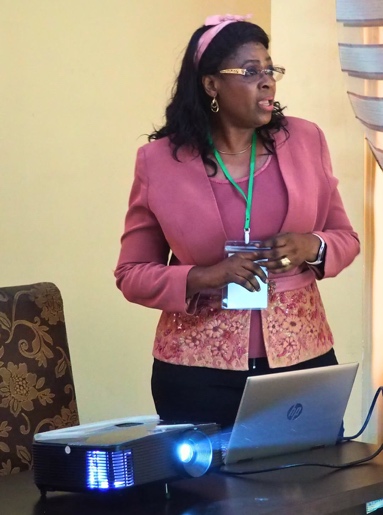 The second day of the seminar was opened by Prof. Oluyemi Fayomi, of the Nigerian Army University Biu. She presented a paper on “Navigating the Ethics of Peace Research in Nigeria: A Qualitative Approach.” Prof. Fayomi underscored how Nigeria’s complex context—ethno-religious conflicts, political instability, and socioeconomic disparities—creates dilemmas that conventional ethical frameworks, often designed for stable environments, do not fully address. She called for prioritizing the safety and security of both participants and researchers, reflexivity about positionality, acknowledging how ethnic, religious, or regional identities can shape research, and developing a context-specific ethical framework to guide research in conflict-affected settings. She concluded that “ethical research in Nigeria requires a continuous and adaptive process.”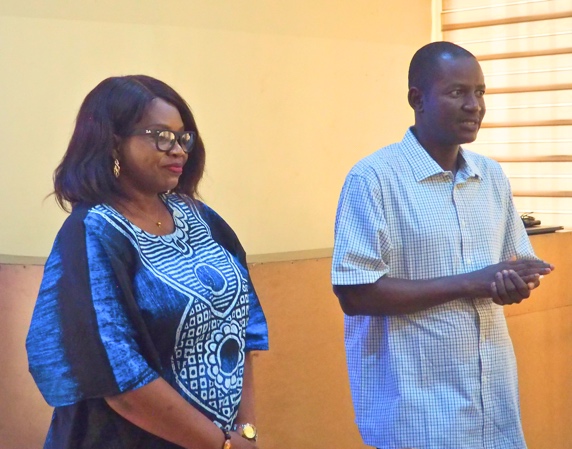
The presentation was followed by reflections on the contributions and debates of panelists from the session chairs, and a communique presented by Prof. Mngutyo. Lastly, the LOC co-chairs, Dr. Agofure and Dr. Adam, reiterated the high quality of the papers and presentations submitted and expressed their gratitude to the APN and Next Gen for its support.