

Description
The Social Science Research Council and Columbia University Press, with funding from the MacArthur Foundation, introduce a new series of primers exploring the negative consequences of the privatization of risk on health care security, market stability, employment, pension security and provisions for coping with natural disasters.
The purpose of the Privatization of Risk book series is to better explain how privatizing financial risk has affected ordinary Americans. The term “privatization of risk” refers to a basic fact of contemporary American life: namely, that risks which were once public and shared have become largely individual and private. Over the last thirty years many American politicians, intellectuals and ordinary citizens have increasingly come to regard private sector solutions as the first and best means of dealing with problems of all kind. It is a shift that has rewritten the economic rules-of-the-road for all Americans and greatly complicated the task of managing both long and short term financial risk.
The Privatization of Risk series illustrates the effects of this shift and suggests possible solutions to the problems engendered by it. Written in accessible prose by some of the country’s leading social scientists, the Privatization of Risk books are primers for understanding and dealing with the individual financial effects of health care insecurity, unemployment, market volatility, pension shortfalls and natural disaster.
- The Risks of Prescription Drugs, edited by Donald W. Light
- Pensions, Social Security, and the Privatization of Risk, edited by Mitchell A. Orenstein
- Bailouts: Public Money, Private Profit, edited by Robert Wright
- Laid Off, Laid Low: Political and Economic Consequences of Employment Insecurity, edited by Katherine S. Newman
- Health at Risk: America’s Ailing Health System–and How to Heal It, edited by Jacob S. Hacker
- Disaster and the Politics of Intervention, edited by Andrew Lakoff

The Risks of Prescription Drugs
ed. Donald W. Light, New York: SSRC/Columbia University Press, 2010.
This volume examines the underlying shifts in the burdens of risks borne by individuals in the world of pharmaceuticals. It argues that commercialized medical knowledge and the rapid increase of drugs prescribed have saddled patients with increased hidden risks and produced an epidemic of harmful side effects.

Pensions, Social Security, and the Privatization of Risk
ed. by Mitchell A. Orenstein, New York: SSRC/Columbia University Press, 2009.
This volume explores the increasing risks borne by today’s workers as they try to plan for the future. It provides concrete solutions for shoring up America’s broken pension and Social Security system.

Bailouts: Public Money, Private Profit
ed. by Robert Wright, New York: SSRC/Columbia University Press, 2010.
This volume examines a number of contemporary and historical bailout efforts and asks the question: Is it wise to rescue private businesses with public money?
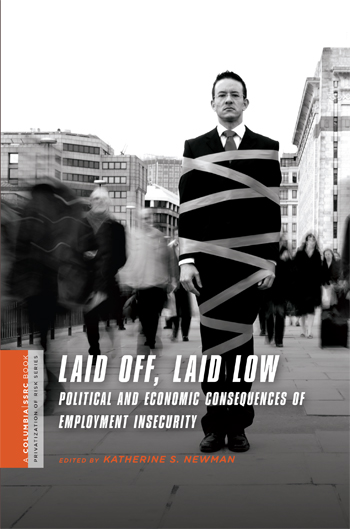
Laid Off, Laid Low: Political and Economic Consequences of Employment Insecurity
ed. Katherine S. Newman, New York: SSRC/Columbia University Press, 2008.
In this volume, economists, sociologists, and public policy experts reveal the perils of the American labor market.

Health at Risk: America’s Ailing Health System–and How to Heal It
ed. Jacob S. Hacker, New York: SSRC/Columbia University Press, 2008.
This volume shines a spotlight on the privatization of risk and America’s healthcare system, bringing the latest research to bear on questions of healthcare policy and dysfunction.

Disaster and the Politics of Intervention
ed. Andrew Lakoff, New York: SSRC/Columbia University Press, 2010.
This volume takes up the issue of catastrophic events and the increasing vulnerability of citizens. How can thoughtful policy interventions improve our capacity to withstand natural and man-made disasters?